The Devil Thinks He's Won. He Hasn't.
Moritz Retzsch painted a chess game in 1831. A century later, someone finally looked at the board.
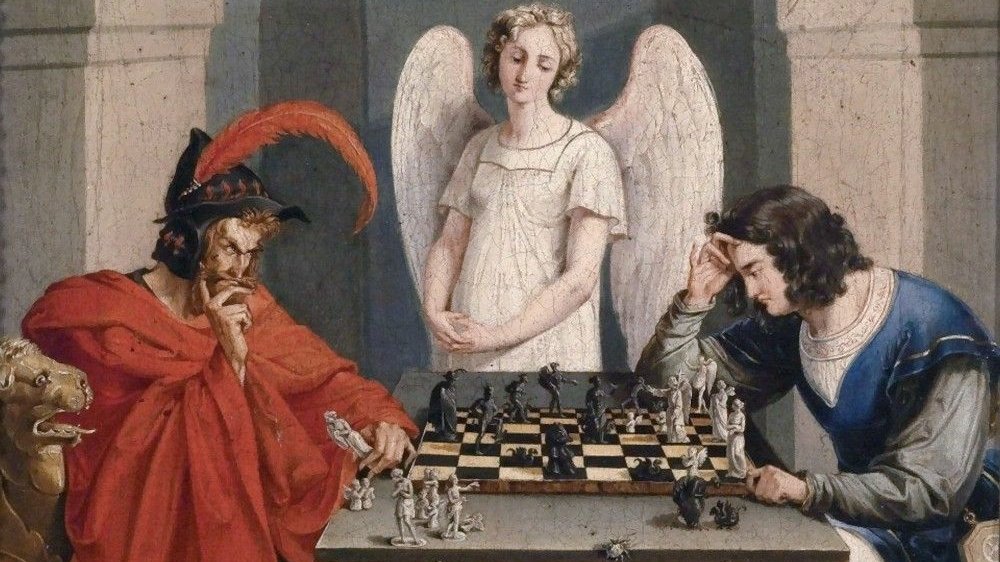
The premise is straightforward, almost clichéd: a young man sits across a chessboard from the Devil. His soul is the wager. He has lost — or so everyone assumed, for decades, looking at this painting.
Then someone actually studied the position.
What Retzsch painted
Friedrich August Moritz Retzsch (1779–1857) was a German artist known mostly for his engravings — meticulous, theatrical, Gothic in sensibility. Schachspieler ("The Chess Players"), painted in 1831, fits him perfectly. It's a scene of absolute despair dressed up in polished oil.
The young man slumps. His pieces are in ruins. The Devil leans forward — smug, composed, one clawed hand resting near the board — clearly satisfied with his work. An angel hovers behind the human player, covering her face. The game appears over. The Devil appears to have won.
The painting is a moral tableau in the 19th-century tradition: pride and temptation lead to ruin, the soul is forfeit, evil wins. Very on-brand for Romantic-era Germany.
Audiences accepted the visual argument. Nobody checked the math.
The American who looked at the board
Paul Morphy was arguably the best chess player in the world in 1858 — an American prodigy from New Orleans who toured Europe, dismantled every grandmaster he faced, and retired from serious chess at 21. Strange man. Extraordinary mind.
The story goes that Morphy encountered a reproduction of the Retzsch painting and spent a long time studying it — not the drama, not the symbolism, but the actual board position. The pieces are rendered with enough detail to reconstruct something like a real game state.
His conclusion, reportedly delivered with characteristic understatement:
"The knight has a move."
The young man hadn't lost. The position contained a combination — a sequence of moves — that the Devil had missed. The human player could still win. The soul wasn't forfeit. The Devil, for all his ancient cunning, had miscalculated.
Why this matters beyond the anecdote
Chess positions don't lie. Either a move exists or it doesn't. Retzsch was a painter, not a chess player, so it's entirely plausible — nearly certain, actually — that he arranged the pieces for visual drama, not tactical accuracy. He wanted the look of a lost position: scattered pieces, exposed king, dominant opponent.
But the consequence is interesting. He may have accidentally painted a position that wasn't lost.
This is a real phenomenon in chess: a position that looks hopeless contains a hidden resource. The defending side has one narrow path — a counterattack, a drawing combination, a perpetual check — that's invisible unless you calculate rather than feel. Grandmasters call these "ghost moves." They exist in the logic of the position regardless of whether anyone sees them.
Retzsch's Devil fell for the same trap that ruins amateur players constantly: pattern recognition mistaken for calculation. The position looked won. The Devil stopped looking.
The deeper game
There's a reason this story has persisted for over a century and a half, passed between chess clubs, reproduced in books about both art and strategy.
It's not really about chess.
The painting is about inevitability — the visual grammar of defeat, the iconography of the soul surrendered. What Morphy's alleged intervention does is puncture that certainty. The narrative the image constructs ("it's over, evil wins") turns out to be based on incomplete analysis. Someone looked harder and found what everyone else had accepted as settled.
Cognitive scientists who study expert perception have a name for what Morphy did: functional fixedness inversion. Non-experts see a configuration and accept its apparent meaning. Experts decompose it — piece by piece, move by move — and sometimes find that the apparent meaning is wrong.
The angel wept too soon.
What nobody can fully settle
The story is almost certainly apocryphal in its exact details. Whether Morphy actually stood in front of the painting and said those words, whether the board position as Retzsch painted it genuinely contains a forced win — these are questions that chess historians have circled for decades without consensus.
What is certain: the painting exists, the position has been analyzed, and at least some reconstructions of it yield a resource for the human player that the surface reading misses.
Which may be the point. Art that rewards looking harder than you thought you needed to — that's rarer than it should be.
Find it: Reproductions are everywhere. The original is held in a German private collection. Study the board position first. Then look at the Devil's face.
He's not as confident as he seems.
3 comments