Taste Is the New Moat
AI companies are opening coffee shops, designing limited-edition hats, and quoting French philosophers. The New Yorker calls it taste-washing. The founders calling it the future of business are not entirely wrong.
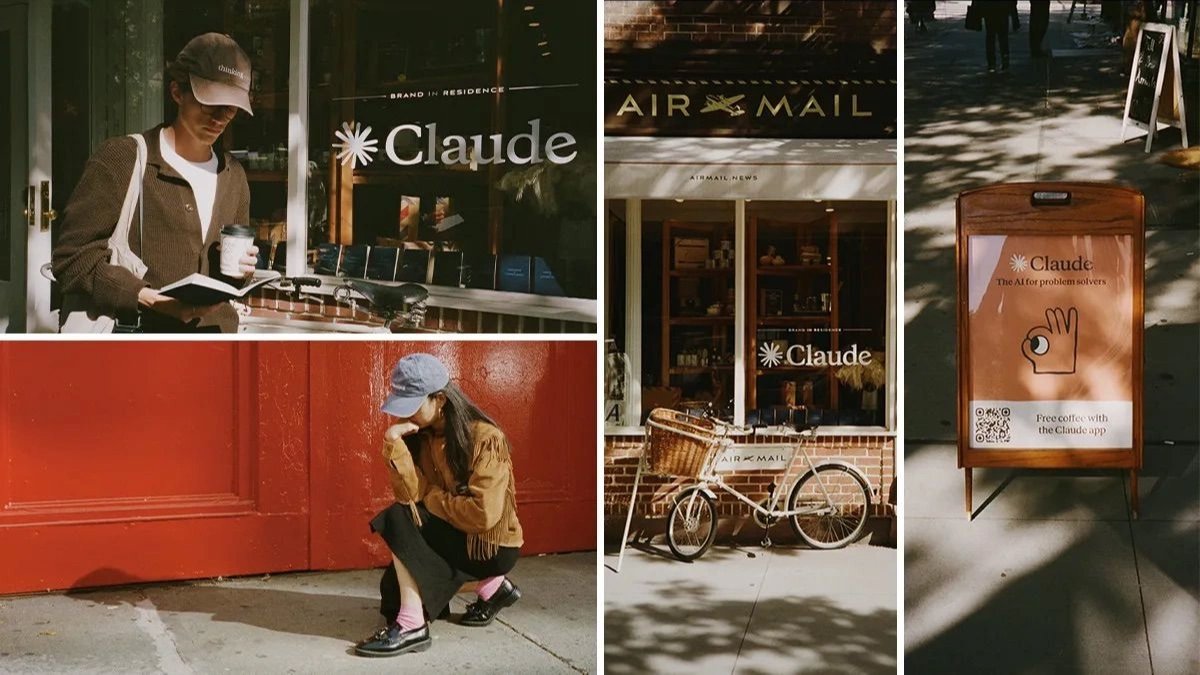
In early October 2025, a temporary coffee shop appeared at Graydon Carter's Air Mail Newsstand in Manhattan. The coffee was free. The branded baseball caps had a single word printed on them. Thinking.
Over five thousand people came through the doors in seven days. The caps ran out almost immediately. Anthropic, the company behind Claude, did not run a single advertisement promoting the event. The line formed because the people in it had already heard, through the same private channels that distribute everything else worth knowing in technology, that Anthropic was doing something cool.
A few months earlier, Perplexity opened a permanent location in Seoul called Café Curious. An AI DJ chose the music. Human baristas made the drinks. Subscribers to the company's twenty-dollar product got fifty percent off. Non-subscribers received a QR code for a free trial. The whole apparatus was designed to make AI feel like something you might encounter on a normal Sunday afternoon, between an art opening and dinner.
These are not isolated marketing experiments. They are an entire category. Notion has been running Cafe Notions since 2022. Microsoft did "Coffee with Copilot" at twenty Best Buy locations. Ramp, the AI fintech startup, runs coffee-cart pop-ups regularly. Modal AI partnered with the premium coffee brand Cometeer for branded giveaways.
The pattern is identical across every example. An AI company builds a physical, aesthetic, low-tech experience and lets the people who would buy their product walk into it.
The word that broke out
The word that does most of the work in this new strategy is taste.
Taste, in the way Silicon Valley now uses it, means a specific kind of human judgment. The ability to look at twelve generic AI outputs and pick the one that feels right. The ability to design a product that does not look like every other AI product. The ability to recognize, when nobody can articulate the rule, that something is or is not cool.
Sam Altman has been explicit about this. He recently called Brian Chesky, the co-founder and CEO of Airbnb, "the most auteur founder of this generation." Chesky has a degree in industrial design from the Rhode Island School of Design. He approaches Airbnb's product launches the way a filmmaker approaches a movie release. Altman's compliment was not really about Chesky. It was about a category of founder that did not exist as a category until recently.
That category is the founder whose primary skill is taste, and whose taste is what makes their company hard to copy.
The argument for taste
The reason taste is suddenly valuable is structural. AI is automating most of the things that used to require skill. Writing reasonable copy. Producing serviceable design. Generating standard code. Composing acceptable music. The output is not always great, but it is usable, free, and infinite.
When the supply of usable output becomes infinite, the value moves to whoever can choose well. The bottleneck stops being execution and starts being judgment. The person who can look at a thousand AI-generated logos and pick the right one is more valuable than the person who can produce the logos. The director, in other words, becomes more valuable than the camera.
Taste is the word the industry has settled on for this skill. It is imprecise, but it is broadly correct. The founders who win in an AI-saturated world are the ones who can hold a strong aesthetic position when everyone has access to the same tools.
Kyle Chayka's counterargument
This is where The New Yorker enters the story. Kyle Chayka, the magazine's leading critic of digital culture, wrote a column in early 2026 arguing that the obsession with taste in Silicon Valley is not what it appears to be.
He named the phenomenon taste-washing. His argument was sharp. AI tools, in their current state, produce work that most people outside Silicon Valley find unappealing or actively threatening. The technology automates the cultural production that humans have historically used to define themselves. Reasonable people are afraid of this.
The response from AI companies has not been to address the substance of the concern. It has been to wrap the technology in the aesthetic markers of human craft. The pop-up coffee shop. The hand-illustrated brand identity. The limited-edition merchandise that signals refined sensibility. The carefully chosen physical bookstore for a launch event. These are the cultural markers of a humanist enterprise. They are also being deployed by companies whose actual business is replacing human creative labor at the largest possible scale.
This is what Chayka means by taste-washing. The same way greenwashing dresses extractive companies in environmental virtue, taste-washing dresses anti-humanist technology in liberal humanism. The function is identical. The visible aesthetic creates emotional permission to accept what the underlying product is doing.
To support his argument, Chayka points to a New York Times poll in which roughly half of readers preferred AI-generated text to passages by canonical authors. He reads this not as proof that AI writing is good, but as evidence that the larger digital environment has eroded readers' ability to distinguish genuine quality from competent imitation. The fact that taste itself is being undermined by the same technologies makes the marketing of taste even more cynical.
The harder truth
The interesting thing is that both arguments are correct, simultaneously.
Taste really is becoming the most important skill in an AI-saturated economy. The founders who can hold a position, choose well, and make their products feel genuinely different from generic AI output will build the next generation of valuable companies. This is not hypothetical. It is already visible in the products that are winning attention from sophisticated users.
At the same time, the language of taste is being deployed strategically by companies that need to soften public perception of their actual product. The coffee shops and the hats and the design-led launches are not just expressions of taste. They are also a PR program. Both things are true at once, and pretending otherwise gives founders too much credit and consumers too little.
The honest read is this. The companies that develop genuine taste, in the deep sense of consistently making things that feel intentional and right, will win. The companies that deploy taste as a marketing layer over a generic product will get a few months of free press and then be forgotten. Most companies will try to do both. A few will succeed at the first. Many will be exposed at the second.
Silicon Valley has discovered taste. The question that decides the next decade is whether it has actually developed any.
1 comment