Why tech scaleups are entering Formula 1
When Revolut and ElevenLabs enter Formula 1, the question isn’t sponsorship — it’s influence.

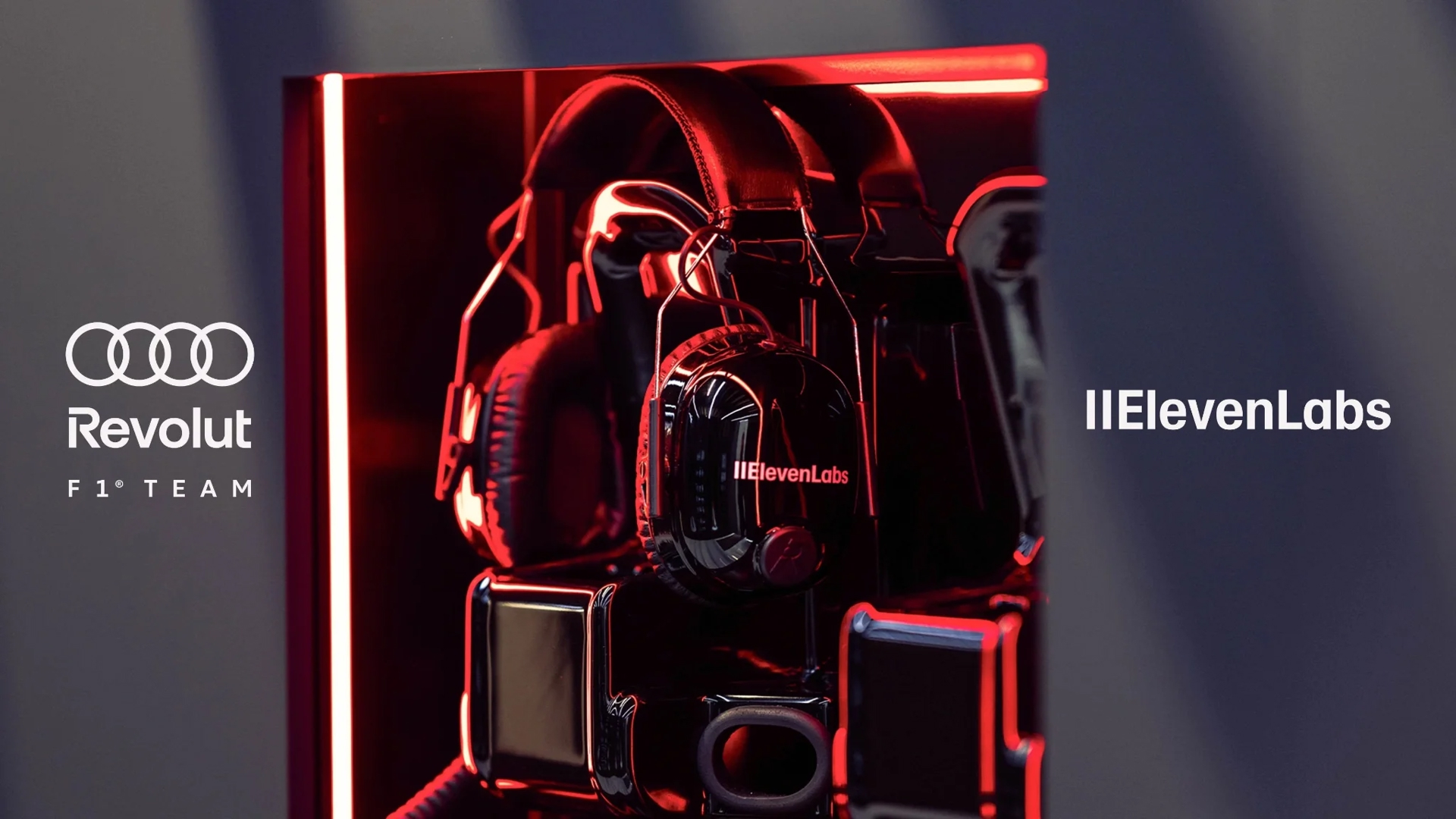
These days, Formula 1 is everywhere again. Season 8 just dropped on Netflix, timelines are full of race commentary, and racing sport has firmly re-entered mainstream culture. I wasn’t particularly following it — and honestly, I still don’t haha.
But the Audi Revolut F1 Team made me care.
When Revolut and then ElevenLabs became official partners of the Audi F1 Team, Formula 1 stopped looking like a sports story to me and started looking like a playground of trends.
For decades, F1 sponsorship was dominated by institutional giants: enterprise tech, global banks, and luxury conglomerates. Companies like Mastercard, Oracle, Santander, and LVMH didn’t just advertise there — they reinforced their position as established players of the global economy.
Now venture-backed European scaleups are stepping onto the same grid. Which raises a bigger question: why enter one of the most capital-intensive branding arenas in the world, and what kind of ROI do they expect in return?
Sport sponsorship as a scale strategy
Both Revolut and ElevenLabs are relatively new to global sports sponsorship, but neither is approaching it casually. Over the past few years, Revolut has expanded its sports portfolio from football partnerships with Manchester City and Como 1907 to rugby club Stade Toulousain — culminating in its Formula 1 title deal with Audi.
In interviews, Revolut’s Chief Growth and Marketing Officer, Antoine Le Nel, frames sport as more than marketing. “We’re here in a competition against traditional banks in the same way we see sport teams competing,” he said. “We use the analogy of us being athletes and trying to compete in the world of banking.”
The analogy is deliberate. Banks have historically been among the most visible sponsors in Formula 1. By entering the same grid, Revolut is not simply increasing brand awareness; it is placing itself symbolically and strategically alongside the players it intends to replace.
The company’s growth metrics support that ambition. Following a late-2025 secondary share sale, Revolut’s valuation surpassed $75 billion, placing it among Europe’s most valuable private technology companies. Since its launch in 2015, the fintech has scaled to more than 65 million customers globally. It now reportedly accounts for roughly one-third of all new digital banking accounts opened in Europe, a data point highlighted publicly by a16z’s Alex Immerman.
Financially, the expansion is equally aggressive. Revenue is projected to reach $5.9 billion in 2025, while its business division alone has already crossed $1 billion in annualised revenue. The company is targeting 100 million customers by mid-2027 and is pushing deeper into B2B financial infrastructure, supported by a planned $13 billion global investment programme over five years.
“And there’s no better platform than sport to put us on the map right now,” Le Nel argues, framing sponsorshias a part of a broader global expansion strategy.
What is changing is not only who sponsors Formula 1 but also the logic behind sponsorship.
Revolut’s Head of Partnerships Deborah Wajsbrot has described 2026 to me as potentially “the end of partnerships as passive logo placement deals.” Instead, brands are expected to embed themselves into the operations and experience of the entities they sponsor.
***2026 marks the end of partnerships as passive logo placement deals.***
The Audi F1 deal reflects that shift. Revolut’s business platform will power payments and checkouts within the team’s ecosystem, including merchandise transactions. In other words, fans will not only see the brand — they will use it. The team becomes a live demonstration of the product operating at scale, under global visibility and pressure.
If traditional sponsorship was about association, this model is about integration.
If Revolut represents financial infrastructure, ElevenLabs represents narrative infrastructure.
Founded only a few years ago, ElevenLabs has grown rapidly into one of Europe’s most visible AI companies. The company closed 2025 with over $330 million in ARR and recently raised $500 million in Series D at a valuation exceeding $11 billion. Its voice AI products and tools are already used by Time, Nvidia, Meta, Salesforce, Klarna, Revolut, and Boston Consulting Group.
Formula 1, meanwhile, is not simply a championship; it is a global content ecosystem. Multilingual broadcasts, constant digital storytelling, race commentary, interviews, and fan engagement make it one of the most media-intensive sports properties in the world.
For ElevenLabs, the partnership is also less about brand exposure and more about embedding its voice technology into how stories are told and distributed across languages and markets. Its tools are designed to support communication at scale — not only internally within teams, but externally across global audiences. In that sense, the partnership is infrastructural.
For decades, Formula 1 symbolised institutional dominance. Revolut and ElevenLabs do not yet match those players in absolute size, but they operate according to a different logic.
Scaleups today are not entering sponsorship as a reputational afterthought. They are approaching it as an extension of the product and growth strategy. Partnerships are measured less by impressions and more by acquisition, feature usage, and retention.
***As Wajsbrot puts it, each major partnership is treated like a product launch — with hypotheses, testing, and performance thresholds.***
This shift reflects broader changes in audience behaviour. Attention is fragmented, competition is faster, and brands are increasingly expected to co-create experiences rather than simply appear alongside them. In that environment, visibility alone is insufficient — integration matters more.
For scaleups, it is not simply about awareness; it is about the ability to operate inside cultural arenas that historically belonged to heavyweights — companies with annual revenues often run into the tens of billions of dollars.
Which is why the more interesting question may not be why tech scaleups are entering Formula 1. It is what happens to the meaning of sponsorship — and of cultural authority — when they do.
would you like some coffee? pay by revolut cards
0 Comments